
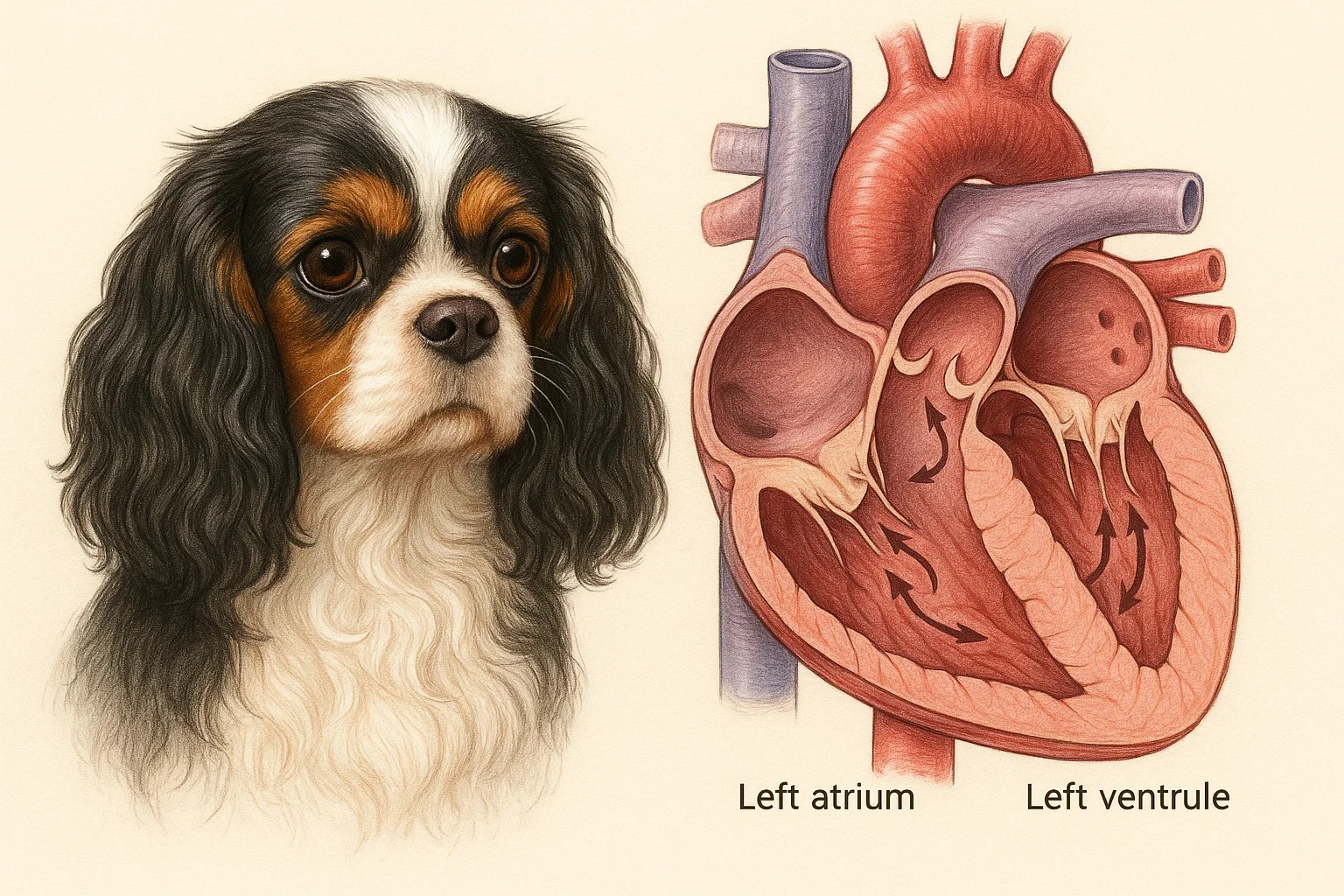

Two major new studies have reaffirmed the importance of early detection and intervention in dogs with myxomatous mitral valve disease (MVD), the most common form of heart disease in canines. The research not only reinforces the clinical value of pimobendan for dogs with advanced heart murmurs but also paves the way for earlier diagnosis through microRNA biomarkers.
Pimobendan Significantly Improves Outcomes in Dogs with Audible Heart Murmurs
A groundbreaking VetCompass study, led by the Royal Veterinary College (RVC), has confirmed the positive impact of pimobendan treatment in delaying congestive heart failure (CHF) and extending survival in dogs with preclinical degenerative mitral valve disease (DMVD). Using an innovative method known as “target trial emulation,” researchers analysed anonymised clinical data from over 100,000 dogs receiving first opinion veterinary care in the UK in 2016.
The study builds on the findings of the RVC’s earlier Evaluation of Pimobendan in Cardiomegaly (EPIC) trial (Boswood et al., 2016), a randomised controlled trial (RCT) that found pimobendan significantly delayed CHF and improved survival in dogs with stage B2 DMVD. The EPIC trial reported a median extension of 462 days to a composite endpoint (CHF, cardiac-related death, or euthanasia), with median overall survival of 1,059 days in treated dogs versus 902 days in untreated dogs.
To replicate the EPIC trial’s structure using real-world data, the VetCompass team examined 928 small breed dogs (≤15kg and over six years old) diagnosed with a grade IV/VI heart murmur. Of these, 178 dogs (19.2%) were prescribed pimobendan within six months of diagnosis, while 750 (80.8%) were not. Advanced statistical modelling balanced the groups across key variables including breed, age, insurance status, comorbidities, and diagnostic access.
Key findings included:
- Risk of CHF at five years was 34.1% in dogs prescribed pimobendan versus 56.3% in those not treated.
- Five-year survival was 19.8% for treated dogs compared to 9.6% for untreated dogs.
- Dogs on pimobendan had 311 fewer days lost to CHF within five years.
- Adjusted mean survival was 1,051 days in treated dogs versus 905 days in untreated dogs.
Dr Camilla Pegram and Dr Dan O’Neill of the RVC stated:
“This study showcases how target trial emulation within VetCompass can generate robust, clinically meaningful evidence, particularly in situations where randomised controlled trials may not be feasible… This study is a game-changer for what future questions can be asked and answered using VetCompass.”
Professor Adrian Boswood, lead author of the original EPIC trial and co-author of the VetCompass study, added:
“Patients with presumed DVMD, with a very audible heart murmur, may benefit from treatment with pimobendan, even if they have not undergone echocardiography… This may benefit dogs where it is not possible to follow current treatment guidelines for financial reasons or where access to advanced diagnostic imaging is not available.”
Dr Jane Murray of Dogs Trust concluded:
“The information provided by these results allow vets and owners to make more informed decisions about how and when to medicate dogs with heart disease, improving life expectancy and quality of life.”
Breakthrough in Early Diagnosis Using MicroRNA Biomarkers
In a parallel development, a pioneering study by veterinary diagnostics company MI:RNA has demonstrated the potential of microRNAs as powerful biomarkers in the early detection and staging of MVD.
Published in Frontiers in Veterinary Science, the study involved 123 dogs and was conducted in collaboration with the University of Liverpool’s Small Animal Teaching Hospital. The findings confirmed that microRNA profiles could effectively distinguish between healthy dogs and those with MVD, while also identifying disease stage – differentiating between preclinical and clinical cases.
Dr Robert Coultous, Chief Scientific Officer and co-founder at MI:RNA, said:
“Early detection is essential for significantly improving the longevity and quality of life of dogs, especially those at risk for this challenging disease. Our research marks a significant advance in personalised veterinary care and diagnostic technique.”
MI:RNA’s approach harnesses molecular diagnostics and predictive modelling to offer efficient and reliable screening. According to the researchers, the technology shows strong potential not just in cardiology but in broader veterinary applications.
Dr Coultous added:
“Our collaborative study strengthens our commitment to enriching and extending the lives of pets, guided by our innovative diagnostic platform and deep dedication to their well-being.”
Cutting‑edge surgery offers hope for advanced cases
In addition to medical and diagnostic advances, surgical innovation is emerging as a powerful option for dogs with severe, advanced mitral disease. In April 2024, the Cummings School at Tufts University reported their first-ever transcatheter edge‑to‑edge repair (TEER) of the mitral valve in a dog named Rabbit, who was suffering from congestive heart failure.
This minimally invasive procedure allows correction of the leaky valve via a small chest incision and catheter, while the heart continues beating – offering a potentially curative alternative to open‑heart surgery. Within days, Rabbit’s heart size had reduced, her breathing improved and, according to her owners, she was joyfully “rabbit‑bounding” again.
The success has prompted Tufts to perform at least 15 such TEER procedures to date, with most dogs experiencing better breathing, regained vigour and improved quality of life. As Dr Emily Karlin observed, this novel procedure “has the potential to help a lot of pets” and represents a major step forward in treating canine heart failure.
Conclusion
Together, these studies represent a leap forward in both diagnosing and treating canine MVD. From the innovative application of big data in clinical treatment trials to the development of cutting-edge molecular diagnostics, the future of canine heart care is shifting towards earlier intervention and more individualised treatment plans – with promising outcomes for dogs and the people who love them.
Breeds Most Affected by Mitral Valve Disease: What Dog Owners Need to Know

Myxomatous Mitral Valve Disease (MVD) is the most common heart condition in dogs, particularly affecting smaller breeds and older animals. Understanding which dogs are most at risk is essential for early detection and effective management.
Most At-Risk Breeds
Research from the Royal Veterinary College and VetCompass has identified several breeds with a significantly higher prevalence of MVD:
- Cavalier King Charles Spaniels
- King Charles Spaniels
- Whippets
- Toy and Miniature Poodles
- Yorkshire Terriers
Among these, Cavalier King Charles Spaniels are particularly vulnerable. According to Mattin et al. (2015), around 1 in 28 dogs in England are affected by MVD – but for Cavaliers, it’s far more common, with many developing murmurs by age 5 or earlier.
Why These Breeds?
The increased risk is largely genetic. In Cavaliers, MVD is thought to be a hereditary condition, passed down through generations due to limited gene pools. Other small breeds also share anatomical and physiological predispositions, including valve structure and heart size.
What It Means for Owners
If you own one of these breeds, especially a Cavalier, it’s important to:
- Request regular heart checks from your vet, especially from the age of 5 onwards.
- Listen for murmurs: Many cases are first identified during routine exams when a vet hears a grade III or IV murmur.
- Don’t dismiss early signs – coughing, reduced stamina, and increased sleeping could be subtle indicators.
- Know that help is available: Medications like pimobendan have been shown to delay the onset of heart failure and extend survival, even before symptoms develop.
Early Detection Can Save Lives
New diagnostic tools, such as microRNA blood tests, are in development and may soon offer even earlier diagnosis – particularly useful for preclinical cases that haven’t yet developed a murmur.
“Early detection is essential for significantly improving the longevity and quality of life of dogs, especially those at risk for this challenging disease.”
– Dr Robert Coultous, MI:RNA
Second photo by Geoff Oliver on Unsplash
